
Our Mission
AAPI Equity Alliance (AAPI Equity) is dedicated to improving the lives of Asian Americans and Pacific Islanders through civic engagement, capacity building, and policy advocacy.
Our Vision
AAPI Equity Alliance envisions an abundant world where AAPIs thrive in safe, healthy, and strong communities, where they are empowered to live authentically.
Our Values
- Equity
- Optimistic
- Transformation
- Authenticity
- Unity
- Community Engagement
Our History
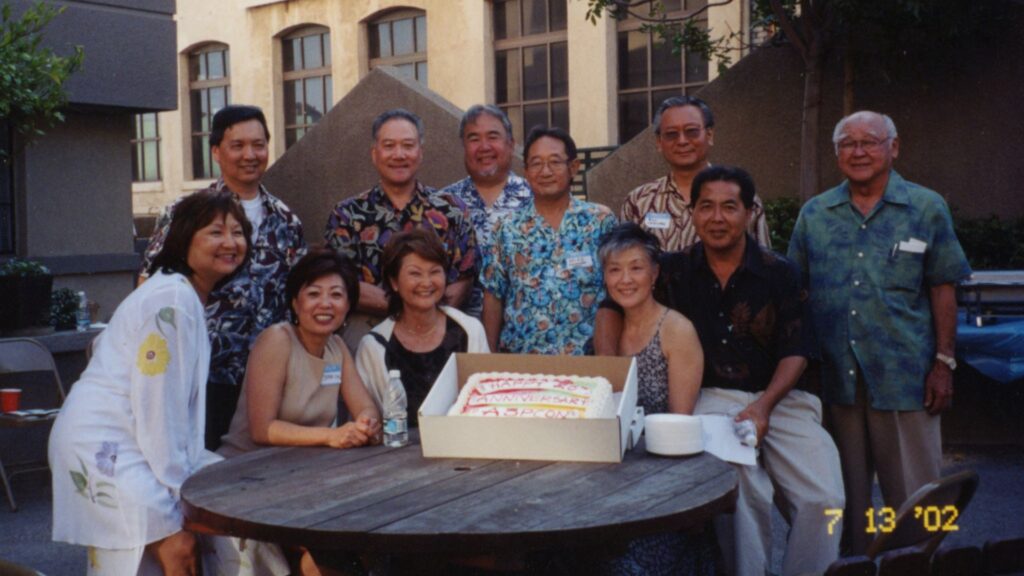
The “Asian Lunch Bunch”, formally known as Asian Pacific Planning Council (APPCON), gather to strategize how LA County can better meet the needs of the AAPI community.
At the time, AAPIs couldn’t receive critical services and resources in the languages they understood. In 1976, a group of Asian Americans begin gathering monthly to figure out how to bridge the gap, dubbing themselves the “Asian Lunch Bunch” until later formalizing into the Asian Pacific Planning Council (APPCON).
APPCON forms health and mental health committees, eventually securing dedicated Asian units at the LA County’s Department of Social Services and Department of Mental Health.
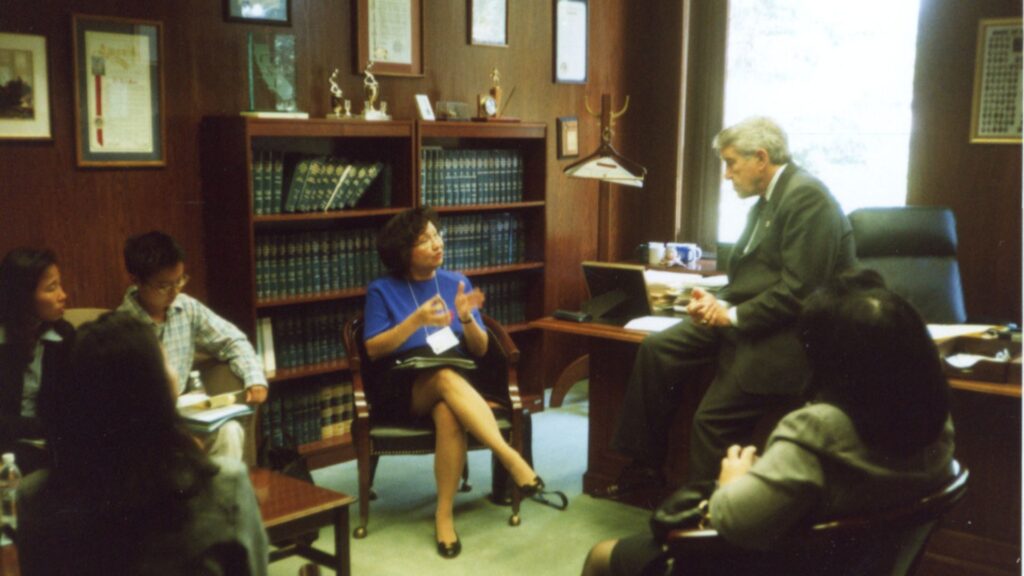
APPCON finds its advocacy voice at local and state levels, supports the formation of key AAPI organizations, and expands committees to confront the challenges facing the community.
A study by APPCON finds that < 0.3% of foundation funds went to AAPI organizations. APPCON secures funding from the LA County Department of Mental Health to support organizations serving AAPIs. They present budget testimonies to underscore the gap in services, leading the Board of Supervisors to investigate the status of County services to AAPIs.
The Older Adults Task Force, Legislative Committee, Aids Task Force, Service Network for AP Youth (SNAPY), and Drug, Alcohol & Tabacco (DAT) committee, and more are formed.
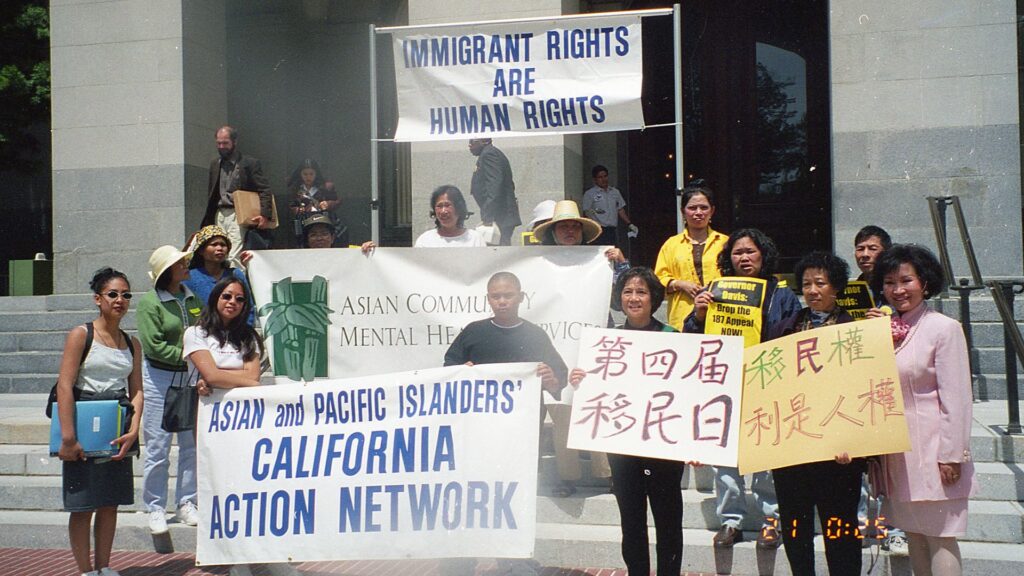
APPCON evolves to Asian Pacific Policy and Planning Council (A3PCON), maximizing its political advocacy, voter engagement, and rapid response to community crises like the 1992 Saigu uprising.
APPCON helps form APIs California Action Network (APIsCAN) and organizes a statewide advocacy day in Sacramento. This led to APPCON’s name change, adding “policy” and evolving into A3PCON in 1996. A3PCON then forms APIA Vote!, a coalition registering and educating AAPI voters.
In response to the 1992 Saigu Uprising, APPCON and its members respond in force to address victim relief and repair relations between ethnic groups. APPCON’s Liquor Store Task Force helps shape policies regarding rebuilding of liquor stores in damaged areas.
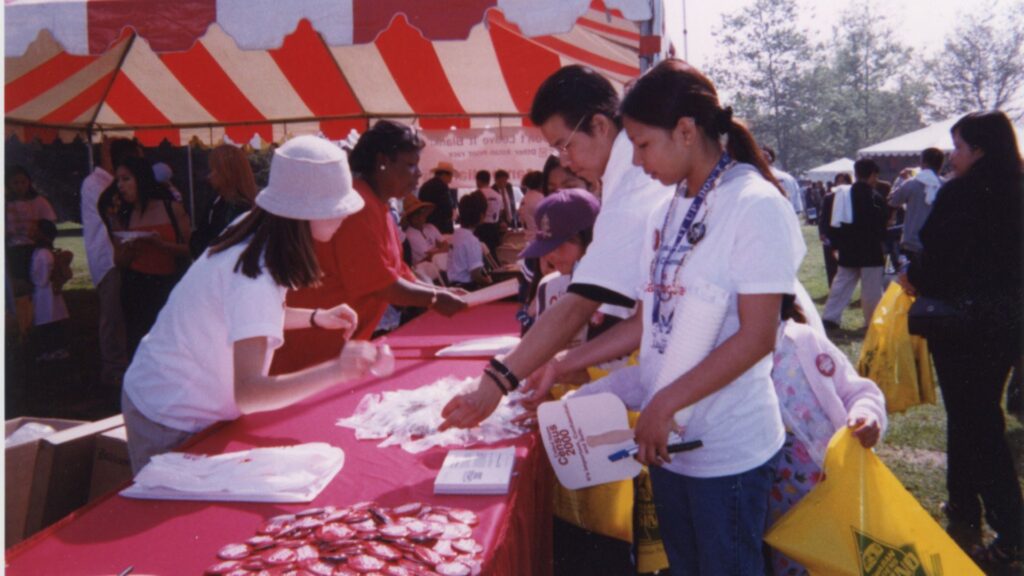
A3PCON becomes a force multiplier, bridging government and AAPI organizations and deepening impact across public safety, civic engagement, mental health, and health.
A3PCON connects government agencies with grassroots organizations to collaborate on increasing access to services, addressing housing insecurity, and demystifying grants.
The Human Trafficking Task Force serves nearly 800 survivors. A3PCON steers 2000 Census outreach and releases voter guides. The Mental Health Committee presents proposals to the Board of Supervisors to address service gaps. The Health Committee secures Asian language interpreters at the County Health Care facilities.
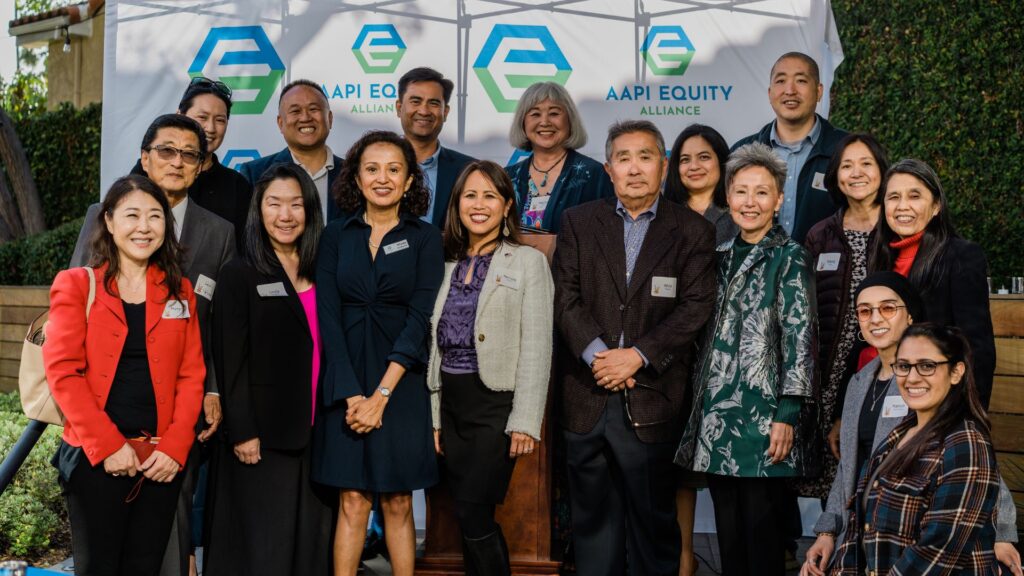
A3PCON is now AAPI Equity Alliance, a coalition of 50 members dedicated to improving the lives of AAPIs in LA County through civic engagement, capacity building, and policy advocacy.
A3PCON is a co-founder of Stop AAPI Hate, the nation’s largest reporting center tracking anti-AAPI hate acts.
On its 45th Anniversary, A3PCON embraces a new name to reflect the coalition’s commitment to equity for all—from responding to crises with in-language services to advocating for inclusive policies at local, state, and national levels.
Today, AAPI Equity Alliance and its members and committees are united to fight for racial equity, close the health equity gap, and build community power for AAPIs.
Before the Beginning of AAPI Equity
The history of social services in the Asian American community has a relatively brief timeframe. Although social services were being conducted by ethnic churches and other welfare service programs (such as the Shonien Children’s Orphanage, which began in the Japanese American community in the early 1900’s), the concept of an Asian American federation or umbrellas of services is relatively new.
As an aftermath of the 1965 Watts Riots and as a part of the free-expression spirit of the 60’s, there was an awakening to the need for service programs in the API community, although back then, API’s were still referred to as “Orientals”.
The first Asian American federation was the Council of Oriental Organizations (COO) which was formed by staff of the County Human Relations Commission in 1968. COO organized the first gathering of API’s at a conference called “Asians Coming Together I or ACT I” which took place at UCLA in July of 1968 and formed the basis to begin seeking funding and programming to serve the API communities.
At that time, there were very few groups serving the API community, but soon, new groups began to form. SSG had been around since the 1950’s, but in the 1970’s, many new groups began to form. These include such agencies as: Chinatown Service Center, PACE, AADAP, KYCC, and ARS. Others formed early but later faded away. It was within this environment of new groups forming and coalescing to form an Asian American federation that A3PCON was born.
In January 1975, there was a meeting called Pacific Asians Coming Together (PACT) which was a followup to ACT I. PACT was called to organize the API communities and a number of committees were formed. This effort eventually led towards the creation of APPCON.
AAPI Equity Timeline
1976-77 – Asian Pacific Planning Council (APPCON) is born. After PACT, a number of API CBO staff, and public agency staff (mostly from the County) began meeting monthly at a information sharing time called the Asian Lunch Bunch. They discussed service needs such as the lack of bilingual services at DPSS, and County Probation. The Lunch Bunch became formalized into the Asian Pacific Planning Council, or APPCON, which as an acronym didn’t really make sense.
1978 – Around this time, Ron Wakabayashi who was then employed by AADAP is elected the first President of APPCON, and health and mental health committees are formed. At this time, county programs such as DPSS, Health, Mental Health, Probation and LAPD could not service API languages; this became a major initial focus for APPCON, and very likely, its major accomplishment over the years.
1980 – Royal Morales, Executive Director of the Asian American Mental Health Training Program is elected the next President of APPCON. APPCON was instrumental in getting the Asian Unit formed at DPSS, and helped in the formation of APCTC at County Mental Health. APPCON is also active in organizing for the 1980 Census, and in supporting the JA Redress movement which was just beginning.
1981 -APPCON sent a delegation of 5 persons to Sacramento to meet with legislators to discuss the distribution of the new “block grant” funding program. APPCON looks into the formation of a cooperative to save money on office supplies for nonprofits.
1982 – Mark Mayeda, Executive Director of the Asian Rehabilitation Services is elected President of APPCON. APPCON has grown to a membership of about 20 agencies and 25 individuals from various public departments. APPCON becomes a major advocacy voice for the API community, especially in dealing with the County of Los Angeles.
1984 – Mike Watanabe of AADAP is elected President in April of 1984. APPCON begins to present testimony before the Board of Supervisors Budget Hearings, focusing on the on-going needs of the API community, especially in the area of health services. An advocacy effort was initiated to get the Department of Mental Health to provide services to API communities resulting in funding to Coastal Mental Health, Long Beach Mental Health, and Asian Pacific Family Center. APPCON pushes the schools of social work to do more API student recruitment. Work begins on Voter Registration, and ongoing discussions with United Way to do more in the API community. Bylaws are now drafted for APPCON and average attendance at monthly meetings is over 20 persons.
1985 – APPCON organizes a major API Health Issues conference on May 31st at USC Davidson Center. The Asian Voluntary Action Center closes operations and the funds (from United Way, ARCO, and the City of LA Mayor’s office) are transferred for APPCON to provide Technical Assistance services to emerging organizations; this becomes the Pacific Asian Resouce Coordination (or PARC Committee) of APPCON. APPCON approves a study group to investigate “designated giving” by employees to support API organizations. APPCON’s budget testimony before the Board of Supervisor’s leads to a motion to investigate the status of county services to API.
1986 – Irene Chu of Chinatown Service Center is elected President in April of 1986. Due in part to APPCON pressure, United Way admits two more API groups to their Member Agency status, for a total of 5 API groups. A winter APPCON retreat was held with 16 people in attendance; points of discussion were: should APPCOCN incorporate, can we make political contributions, should we form an Asian United Way, and should we create a “superagency”? The Mas Fukai Roundtable (information sharing) met monthly in Gardena at the ACSC with 30 people or more in attendance. The AP Older Adults TF and the API Child Abuse Council have been formed. The APPCON Executive Committee takes more of a role in setting agendas.
1987 – APPCON forms the the AP Health Venture and seeks foundation and County support funds. Meetings draw 20 – 40 people and are held at the IndoChinese Refugee Service Center on Beverly Blvd. Planning starts for the 1990 census. API Designated Giving campaign has 8 member agencies to collect United Way donor designations. A statewide API Health/Mental Health Conference sponsored by APPCON was held Nov. 1987. An APPCON Legislative Committee is formed to coordinate City, County and State-wide legislative people. An API Aids Task Force is formed by APPCON which begins outreach and education efforts.
1988 – Bill Watanabe of the Little Tokyo Service Center is elected President of APPCON. APPCON committee meetings use the CSC Annex space (later to become the A3PCON Center). The AP A Community Research Roundtable is formed by APPCON and UCLA staff and they plan the first Roundtable held at UCLA in Nov. 1988. APPCON forms an Outreach Committee to increase other API participation in APPCON. PARC issues a study of local Foundation support for API groups, revealing that less than .3% of foundations funds went to API agencies.
1989 – APPCON conducts the first API Legislative Day in Sacramento in February 1989, co-hosted by Senator Roberti’s API Affairs staff. API Task Force on the Disabled is formed. AP Health Care Venture is incorporated and obtains county and federal funds. APPCON and United Way investigate API service needs in the San Fernando Valley. A new APPCON committee, Service Network for AP Youth (SNAPY) is formed. APPCON issues its first Newsletter, including Committee Updates, Organizational Announcements, and News in Brief. A Drug & Alcohol Task Force is formed (and later becomes the Drug, Alcohol & Tobacco (DAT) Committee).
1990 – Bong Hwan Kim of the Korean Youth Center is elected President of APPCON. The Asian Pacific Community Fund is incorporated. A Housing, Employment, Economic Development Committee is formed. A planning retreat firms up membership and structure issues for APPCON. APPCON participates in an expanded and more state-wide Sacramento Legislative Day, joining over 50 community based organizations from seven counties to advocate for government services to the exploding API population. A Reapportionment Committee is formed. APPCON meets Mayor Bradley to discuss Korean/Black tensions and forms a working committee.
1991 – APPCON hosts the First Annual Job Fair at the Korean Television Enterprise Building; over 150 job applicants attended, and 26 employers were present. APPCON forms an Ethnic Relations Committee to address issues of race relations, with a focus on the deteriorating relations between Blacks and Koreans. APPCON takes over the CSC Annex (CSC was asked to vacate to make way for a proposed hotel development), with AADAP as manager and HCV as the major tenant, along with other groups.
1992 – Deborah Ching of Chinatown Service Center is elected President in April 1992. APPCON hosts planning and funding workshop for APPCON members, attended by over 90 participants, many from Pacific Islander communities. APPCON hosts a candidates forum for the 2nd Supervisorial District and forms a Transportation Committee. APPCON tries to address the challenges brought about by the 1992 Civil Unrest, the most devastating riots in our time.
APPCON and its member agencies respond in force to assist victims of Los Angeles’ civil unrest. With individuals and businesses attacked in Koreatown, South Central, Long Beach and other parts of LA, all communities were hard hit, including Korean Americans, Cambodian Americans, Filipino Americans and Chinese Americans. A new organization, called Asian Pacific Americans for a New L.A. (APANLA) was formed in July 1992 under the direction of APPCON and the Asian Pacific American Legal Center to address victim relief, build links between major ethnic groups, and address policies for business development, law enforcement, and education.
1993 – APPCON holds historic Mayoral Forum as competition heats up between
Mike Woo and Richard Riordan to fill the seat long held by Tom Bradley. Over 300 attended to hear the mayoral and city council candidates. APPCON’ Liquor Store Task Force helps shape policies regarding rebuilding of liquor stores in riot-damaged areas. APPCON assists in the formation of API’s California Action Network (APISCAN).
1994 – Nancy Au of the Western Region Asian American Project becomes President of APPCON. Leadership Education for Asian Pacifics and APPCON sponsor study “Beyond Asian American Poverty,” exploding the Model Minority Myth. APPCON participates in First Annual APIsCAN Legislative Day in Sacramento, joining APA groups from around the state to educate legislators and policy makers about the APA community. APPCON member agencies mobilize to oppose Proposition 187, which would strip undocumented immigrants of access to government services.
1995 – APPCON / APANLA awarded $250,000 from HUD for training and technical assistance to help API groups address housing and economic development projects. 17th Annual LA APA Heritage Month honors APPCON with its Community Organization Award. APPCON’s new Telecommunications Committee provides up to $1000 for APPCON member agencies to assist in setting up e-mail on their computers, and free e-mail addresses for one year to 22 groups. APPCON assists Thai garment workers freed from enslaved work conditions in El Monte by rallying with donations and assistance. APPCON grows to 50 member organizations, and Nancy chairs a series of meetings regarding APPCON’s need to re-structure and formulate guiding principles. A new set of Bylaws are drafted.
1996 – Sam Demonteverde of the Older Adults TF is elected Chairman of A3PCON and for the first time, APPCON has a paid Executive Director in the person of Warren Furutani. After a planning retreat in Big Bear, APPCON evolves into “A3PCON,” the Asian Pacific Policy and Planning Council. The new structure will allow A3PCON to not only continue planning and coordinating the member agencies in their provision of services, but also maximize the collective ability to develop and educate on policy positions. A3PCON organizes historic September 1996 Rally on steps of LA City Hall to have a physical show of the API community’s force. APPCON also rallies to oppose Proposition 209, which would abolish affirmative action. A3PCON also supports efforts to register voters and get out the vote in November 1996.
1997 – A3PCON makes history by co-sponsoring a legislative hearing on the Imapct of Welfare Reform. Over 700 attendees packed the LA County Hall of Administration to listen to API’s testify about the personal impact the welfare cuts would have on their lives and was covered on the front page of the LA Times. A3PCON holds an “agenda-setting gathering at Edison offices attended by 200 participants.
1998 – A3PCON forms APIA Vote!, a coalition of organizations dedicated to registering and educating voters and turning out the vote. A3PCON organizes Asian and Pacific Islander Community Child Care Workshop to assist organizations interested in providing child care services. Building at 300 Cesar Chavez officially named “A3PCON Center.”
1999 – Gladys Lee of Asian Pacific Family Center/Pacific Clinics is elected the President of A3PCON and Dennis Arguelles replaces Warren Furutani. A3PCON spearheads community-wide Census education to mitigate the 2.3% undercount of Asians and Pacific Islanders. A major effort is underway to deal with Welfare Reform issues, and consolidation plans within the County structure which impacts services for API’s. A3PCON spearheads the Census 2000 outreach effort for API’s in LA County. A3PCON Housing & Economic Dev. Committee launches an API Small Business assistance program.
2000 – Kazue Shibata of AP Health Care Venture is elected President, succeeded by Dennis Arguelles in December 2000. APPCON hosts meetings for the White House API Initiative. A Re-Structuring Committee re-affirms the policy that A3PCON will not be a direct service agency but to coordinate and plan/advocate services provided by others. A3PCON Health Committee hosts trainings on Language Access issues.
2001 – Ford Kuramoto of the National Asian Pacific American Families Against Substance Abuse (NAPAFASA) is elected President of A3PCON. There is a proposal that A3PCON should, at last, incorporate. The A3PCON Center site is first notified in December that it may be threatened with eviction by a new El Pueblo development project slated for the lot where the Center is now located. Following 9/11, A3PCON engages in anti-hate crime activities.
2002 – A3PCON and APALC jointly release a new report entitled “Immigrant and Refugee Children Left Behind… Asian and Pacific Islander Families in the Aftermath of Welfare Reform.” A3PCON is incorporated and files for 501 c (3) tax exempt status. A3PCON releases a voter guide highlighting the APIA need for several propositions.
2003 – A3PCON actively campaigns against Proposition 54, the information ban that would make it illegal for state and local agencies, schools, hospitals, and law enforcement, to collect or analyze data on race, ethnicity, color or national origin. The proposition fails. A3PCON distributes information on SARS to address devastating impact SARS has on API-run businesses.
2004 – A3PCON produces a Voter Guide on California Propositions. The guide is reproduced and sent to hundreds of voters, it is also translated into Korean by the Korean Resource Center and distributed to Korean voters. A3PCON also holds a press conference to urge Governor to protect newly established Commission on API affairs. A3PCON holds a signature event for member organization addressing fundraising strategies during state, federal and local budget cuts.
2005 – A3PCON moves offices to the Refugee Service Center. A3PCON holds a press conference addressing new concerns in Tsunami Victim Relief and announces local efforts to help victims. The commission on API affairs is saved. A3PCON hosts “The Future of Los Angeles: Immigrant Communities Mayoral Forum.”
2006 – Participated in Los Angeles County policy and budget development process, including formulating position paper articulating API community issues and priorities, meeting with Supervisors Deputies and providing testimony during the County Budget Hearings in May (Feb-May). Moved A3PCON office and stabilized administrative operations (Feb.).
Conducted training on non-profit organizations and participation in electoral and political affairs. Speakers included the Honorable Warren Furutani (June). Established Equitable Development Task Force to research, educate and develop A3PCON strategies around critical issues of gentrification, displacement and affordable housing in traditional API enclave communities. Received support from Southern California Edison to organize series of receptions/networking sessions between A3PCON members, the Asian Pacific American Legislative Staff Network (APALS) and Asians and Pacific Islanders in Philanthropy (APIP) (Nov.)
Held 30th Anniversary Luncheon Celebration. Over attended 200 attended. Exceeded fundraising goals and received widespread corporate and foundation support. Recognized founding A3PCON members with key note address provided by Warren Furutani (June). Held strategic planning retreat to establish goals and priorities for 06-07 program year. Gentrification, Cultural/Linguistic Access to County Services and Human Services Resource Allocation identified as priority issues (Sept.).
2007 – Some of year 2007’s activities included:
- A “New Wave in Philanthropy” conference, co-sponsored by AAPIP that gave agencies an opportunity to meet foundation officers
- Success in advocating for Asian language interpreters at County Health Care facilities
- Meeting with the new County CEO, Bill Fujioka to present API priorities and needs
A well-attended APA Community Research Roundtable Summit on “Turning Data Into Action” - An active role in developing strategies with the Department of Mental Health and the Board of Supervisors to find ways to mitigate the County General Fund cuts
- Increased membership and raised the largest amount of revenue ever
2011
- Community Meetings: A3PCON was involved in community meetings for fair redistricting in the San Gabriel Valley area of Los Angeles County.
- Research Collaboration: A3PCON collaborated with UCLA’s Asian American Studies Department and Urban Planning Department on a research project regarding the impacts of transit-oriented development (TOD) on Asian American and Native Hawaiian/Pacific Islander communities in Los Angeles County, including a focus on Little Tokyo with partnership with the Little Tokyo Service Center.
2013
- Community of Contrasts Report: A3PCON contributed to Asian American Advancing Justice Los Angeles’ “Community of Contrasts” report, a series using disaggregated data to highlight the diverse social and economic needs of the AAPI communities in various regions, including Los Angeles County and the Northeast.
- Research Conference: A3PCON collaborated with the Asian American and Pacific Islander Policy Research Consortium (AAPIPRC) for the 2013 AAPIPRC Conference, which focused on the value of surveys for public policy planning and featured national, state, and local data collection efforts.
2014
- White House Grant-writing Workshop: The White House Initiative on Asian Americans and Pacific Islanders (WHIAAPI) Regional Interagency Working Group (RIWG) partnered with A3PCON, Asian Americans Advancing Justice—Los Angeles, and East Los Angeles College to host a grant-writing workshop. Nearly 150 local AAPI community advocates and leaders attended the all-day training to gain a deeper understanding of grant research, writing, and approval.
- Community Roundtable: Nearly 100 advocates for AAPI communities in Los Angeles met face-to-face for the first community roundtable in the city hosted by the WHIAAPI RIWG. The vision was to help communities overcome barriers to accessing services through the collaboration of government and community groups. Advocates shared approaches and challenges while RIWG members shed light on their legal mandate to remedy disparities. The roundtable also included a session on best practices in applying for federal grants.
- A3PCON’s API Human Trafficking Task Force Milestones: In 2014-2015, Task Force agencies provided services to more than 764 Human Trafficking clients in the greater Los Angeles area. 434 of those clients, or 57%, were API. Among API ethnicities, Filipinos, Thais and Koreans had the highest numbers of Human Trafficking cases. (Thais: 228 survivors, Filipinos: 114 survivors, Koreans: 35 survivors)
2015
- Fact Sheet on AAPIs and Affordable Housing: USC Roybal and A3PCON’s API Older Adults Task Force partnered to release a fact sheet to bring awareness to the high rent burden on AAPI communities in Los Angeles County, indicating ongoing advocacy efforts in this area around that time.
2016
- Human Trafficking Press Conference: A3PCON’s API Human Trafficking Task Force hosted a press conference to address the needs of survivors in the Los Angeles area. Data shows that 57% of human trafficking clients in the LA area were API individuals, with high numbers for Filipinos, Thais, and Koreans. The press conference also announced the formal launch of A3PCON’s Human Trafficking Task Force.
2017
- New Executive Director: A3PCON welcomed our new Executive Director, Manjusha P. Kulkarni (Manju) to the team. Manju’s work over the decades in the social justice movement demonstrates her significant knowledge in health policy and civil rights as well as her dedication to improving the lives of AAPIs and communities of color.
- DACA Mental Health Project: The organization launched a DACA (Deferred Action for Childhood Arrivals) Mental Health Project to provide free services and support in AAPI languages for individuals experiencing stress and anxiety due to the uncertain political environment.
- Advocacy and Rallies Against Anti-Immigration Policies: 20 A3PCON members joined LA County Supervisor Hilda Solis, LA City Councilmember David Ryu, LAUSD Board President Steve Zimmer and LACCD Trustees Mike Eng and Mike Fong to rally and build defenses against mass deportations and anti-immigrant actions. Los Angeles’ diverse immigrant and refugee communities, including undocumented immigrants, face the increasing peril of their families being torn apart by the anti-immigrant policies of the Trump administration.
- LA County Department of Mental Health (LACDMH) Committee Meetings: A3PCON’s Mental Health Committee hosted joint committee meetings with other stakeholders to discuss community needs and implementation strategies for mental health initiatives from the LA County Report on Mental Health Disparities.
2018
- Proposals to Address Mental Health Disparities: A3PCON’s Mental Health Committee facilitated workgroups to develop four proposals and presented them to the Los Angeles County Board of Supervisors to address gaps identified in a LACDMH report.
- Human Trafficking Task Force Awareness Campaign: A3PCON’s API Human Trafficking Task Force launched an outreach campaign to raise awareness and provide services to survivors in Los Angeles County.
- Civic Engagement and Voter Guide: A3PCON published a voter guide for the November 2018 election, providing positions on various ballot initiatives.
- Raising Community Concerns with Electeds: A3PCON members met with local leaders, such as Assemblymember Al Muratsuchi, to discuss key community concerns like the housing crisis and data disaggregation
2019
- “Power to the People” Conference: A3PCON and the UCLA Asian American Studies Department co-hosted a major conference, “Power to the People”: 50 Years of Bridging Research with Community, to commemorate the 50th anniversary of Asian American Studies at UCLA. The event brought together diverse and inter-generational communities to appreciate the legacies, genealogies, and futures of Asian American studies.
2020
- The Launch of Stop AAPI Hate: At the dawn of the pandemic, A3PCON, Chinese for Affirmative Action (CAA) and the Asian American Studies Department of San Francisco State University joined forces to form Stop AAPI Hate, a national reporting center dedicated to fighting the rise of anti-Asian racism. The effort earned Kulkarni and other Stop AAPI Hate founders the recognition of “Top 100 People of 2021” by TIME magazine for their work fighting violence and hate crimes directed against AAPIs.
- Press Conference: LA Leaders Stand with AAPI Angelenos Against Racism Related to Coronavirus: A3PCON hosted a press conference with local AAPI leaders and public officials to declare that racism and xenophobia related to fears of the coronavirus will not be tolerated in Los Angeles County. Officials urged anyone who experiences verbal or physical harassment to report it, saying all Angelenos have the right to feel safe at home, school, work and other public places.
- Report on Relationship Violence in Five Los Angeles Asian American Communities: With support from the Blue Shield Foundation, A3PCON partnered with 7 member organizations to explore the risk and protective factors of domestic violence in the Cambodian, Chinese, Korean, North Indian Hindu, and Pakistani Muslim communities. The groundbreaking research provides a pathway for deeper work reducing domestic violence in these five communities.
- COVID-19 Rapid Response with Community Health Workers: With the support of LA County Department of Public Health, A3PCON, Asian Resources, Inc. (ARI) and National Asian Pacific American Families Against Substance Abuse (NAPAFASA) led the Community Health Worker Outreach Initiative. The network of 14 partners outreached to highly impacted communities to provide accurate and up-to-date information regarding COVID-19 and connect residents with needed critical services, including health insurance, testing, mental health services and other safety net services such as food pantries and housing assistance.
2021
- A3PCON is now AAPI Equity Alliance: For our 45 Anniversary, we announced a new name: AAPI Equity Alliance. This new chapter emerges at a time of growing health and social disparities for AAPIs, and the unacceptable rising violence and hate targeting our communities. The new name reflects our inclusive coalition of more than 40 members committed to advocating for the rights and needs of AAPIs.
- Stop the Hate California: As part of the API Equity Budget passed by the California State Legislature to combat anti-Asian Hate, AAPI Equity Alliance earned a $474,724 “Stop the Hate” grant from the State of California and named Los Angeles County’s Regional Lead in a groundbreaking effort to stop hate through direct services, prevention and intervention.
- Transformative Grant: The API Equity Budget also allocated funds to 12 organizations doing deeper, transformative work. AAPI Equity Alliance received the Transformative Grant to implement the Healing Our People through Engagement (HOPE) program, a group-based approach to healing from the impacts of racial trauma in 5 Asian and Asian American communities: Chinese, Cambodian, Korean, Japanese, and Filipino.
- Community Health Worker Outreach Initiative: AAPI Equity Alliance continues to address the disproportionate impact of COVID-19 in our communities, reaching more than 200,000 people through virtual and in-person outreach and engagement with critical live-saving resources and combatting misinformation.
- Redistricting Reform: As a member of the People’s Bloc and the AAPI & Arab, Middle Eastern, Muslim, and South Asian (AMEMSA) Redistricting Collaborative, AAPI Equity Alliance and our members worked to preserve the integrity of historic AAPI communities; Koreatown, Historic Filipinotown, Thai Town, Little Tokyo and Chinatown; through community dialogue during the 2021 redistricting process.
2022
- Securing Vote Centers in AAPI Enclaves: Prior to the 2022 primary election, public outcry erupted in Koreatown and Chinatown, when the LA County Registrar revealed that there were no vote centers in these neighborhoods, further disadvantaging vulnerable populations. AAPI Equity Alliance with Korean American Coalition-LA and Center for Asian Americans United for Self Empowerment (CAUSE) championed efforts to identify and secure locations for vote centers in the two ethnic enclaves.
- 2022 Voter Guide: AAPI Equity Alliance’s newly established Civic Engagement Task Force developed a voter guide and one-page flier offering analysis and recommendations for 13 local and state ballot measures. The guide was translated into Spanish and 13 Asian languages including Bengali, Chinese, Hindi, Japanese, Khmer, Korean, Punjabi, Samoan, Tagalog, Thai, Tongan, Urdu and Vietnamese. We also hosted media briefings to provide analysis and guidance on ballot measures’ impact on the AAPI community, including expert commentary from CAUSE, APIAVote and the Check the Sheriff Coalition.
2023
- Rapid Response to Monterey Park Mass Shooting: The tragedy in Monterey Park, which claimed eleven lives on the eve of Lunar New Year in 2023, hit close to home here in our local AAPI community. Chinatown Service Center (CSC) and Asian Pacific Community Fund (APCF) were on the ground immediately providing support and services to the families of the victims and witnesses of the shooting. AAPI Equity Alliance partnered with Asian Americans Advancing Justice Southern California and APCF, CSC, The Asian American Foundation and Gold House, to establish a GoFundMe fundraiser for Monterey Park victims and their families. The fund distributed $1.4 million to families of victims. AAPI Equity Alliance members collaborated to quickly respond and prepare a multilingual directory of resources, including mental health services, emergency food and legal aid.
- A Tribute to AAPI Legacy: Heritage Month Celebration: To acknowledge our collective strength and resilience through grief, AAPI Equity Alliance gathered with our members, partners, and local electeds for “Honoring the Past, Celebrating the Present: A Tribute to AAPI Legacy”, an evening for us to be in community with our AANHPI family, community leaders, and founders of our organization. We were honored to have U.S. Congresswoman Judy Chu and City Councilmember Nithya Raman join us and share remarks.
- Empowering AAPI Professionals: Our Policy team developed the AAPI Resume Bank, consisting of more than 100 AAPIs who seek to share their lived experiences in public service to create a more just and inclusive society. It serves as a pipeline and resource for 7 local government offices to identify experienced AAPI professionals for leadership and employment opportunities.
2024
- Building Political Power with Asian American Trailblazers: AAPI Equity Alliance and the Center for Asian Americans United for Self-Empowerment (CAUSE) co-hosted an event to hear from Asian American trailblazers Warren T. Furutani, Maeley Tom and Bill Wong at the Daniel K. Inouye National Center for the Preservation of Democracy.
- Voter Empowerment through Art: Executive Director Manjusha P. Kulkarni was awarded with the James Irvine Foundation Award. With the award, we ran a visual arts campaign to energize AAPIs to vote in the 2024 Election. With original artwork by LA-based artist Natalie Bui, the campaign centers around five key topics: climate change, community safety, economic stability, family values, and healthcare. AAPI Equity Alliance also developed a voter guide in 14 AAPI languages to inform voters about ballot measures. Our coalition played a key role in turning out voters from San Gabriel Valley and Koreatown for the passage of Measure G, a government reform bill to expand seats on the LA County Board of Supervisors.
- Community in Power: AAPI Equity Alliance released a Community Impact Report reflecting on the milestones of our coalition since our name change in 2021. We’re grateful for the stories of impact from our members dedicated to fighting for racial equity, closing the health equity gap, and building community power.
2025
- LA Wildfires: As the wildfires devastated beloved LA neighborhoods and displaced Angelenos, AAPI Equity Alliance swiftly developed a resource guide, translated into 7 Asian American languages, with critical resources and services offered by our members for survivors and their families. With the UCLA Asian American Studies Center, we released a report detailing Asian American language needs during the fires. Our coalition advocated for a more inclusive, multilingual alert system and resources from the County to reach limited English speaking communities during times of crises.
- Press Conferences & Rallies: The impacts of federal policies tore through immigrant communities as ICE snatched people off the streets, detained folks at their immigration hearings, and spread fear and terror.
- AAPIs in Solidarity Against ICE: AAPI Equity Alliance and our members organized a press conference to demonstrate solidarity with the Latino community and bring attention to how these raids are uniquely impacting AAPIs.
- Reclaim Our Streets: In Long Beach, many Southeast Asians are being detained and deported by attending their scheduled immigration hearings. With We Are California and our members, we organized a community gathering to reclaim our sense of safety. Together, we shared resources and stories from impacted community members and celebrated our culture through song, dance, and food.
- Healing Our People through Engagement: AAPI Equity Alliance and our members completed the HOPE program to help Asians and Asian Americans in LA heal from generational racial trauma utilizing a group-based approach. Stories from participants indicate HOPE to be a powerful mental health intervention tool that not only shifts one’s mindset from coping to healing, but also empowers them to take meaningful action in their communities.
- Stop the Hate Day of Action: More than 300 community leaders from across the state joined us in Sacramento to meet with 92% of the State Legislature and educate electeds on the Stop the Hate program. With hate on the rise, funding is more critical than ever to meet the needs of our communities.
- Protecting Democracy with CA Prop 50: AAPI Equity Alliance came out in full support of California Proposition 50, an effort to level the playing field after Texas moved to redraw its district maps and influence the results of the 2026 Midterm Elections. We developed a voter guide and placed ethnic media ads in Chinese, Korean, Japanese, Indian, Filipino, Thai, and Vietnamese outlets to spread the word to the Asian American communities in Los Angeles.